
How to Find the Best Cafeteria Plan Advisor for Your Business
Choosing a cafeteria plan advisor is not just a benefits decision. It is a payroll, tax, compliance, employee communication, and savings decision.
Many employers already offer health insurance, run payroll every pay period, and provide employees with basic benefit options. On the surface, everything looks complete. But a major question often remains unanswered:
Is your company only using a basic cafeteria plan when a stronger Section 125 benefit strategy could create more value?
That is where the right advisor matters.
The best cafeteria plan advisor does more than explain what a Section 125 plan is. A strong advisor helps employers compare basic cafeteria plan options with advanced Section 125 benefit strategies, evaluate employer payroll tax savings, assess FICA tax savings, coordinate existing payroll, align benefit deductions, identify employee benefit value, and determine whether supplemental health benefits or employee wellness benefits fit the workforce.
For W-2 employers, the wrong advisor creates confusion. The right advisor creates clarity.
Employer Benefits Plan helps business owners, CFOs, HR leaders, payroll managers, benefits brokers, and W-2 employers compare benefit options before implementation. Instead of pushing one plan structure, EBP helps employers evaluate whether a basic cafeteria plan is enough or whether a more advanced tax-advantaged benefit strategy creates stronger value.
Why Choosing the Right Cafeteria Plan Advisor Matters
A cafeteria plan affects more than employee benefits.
It touches:
- Payroll deductions
- Taxable wage calculations
- FICA tax savings
- Employer payroll tax savings
- Employee benefit elections
- Health insurance contributions
- Supplemental health benefits
- Employee wellness benefits
- Medical reimbursement arrangements
- Workers’ compensation savings opportunities
- Compliance documentation
- Employee communication
- Plan administration
This is why employers should not choose an advisor based only on who gives the simplest explanation or fastest setup.
A basic cafeteria plan advisor might only discuss pre-tax premium deductions. That is useful, but it does not always answer the bigger business question:
Are there stronger benefit savings strategies available for this workforce?
The best cafeteria plan advisor should help employers compare options, not just set up the first available plan.
What Is a Section 125 Cafeteria Plan?
A Section 125 cafeteria plan is a written employer-sponsored plan that allows eligible employees to choose between taxable compensation and qualified benefits.
In practical terms, employees direct part of their pay toward eligible benefits before certain taxes are calculated. This structure often helps employees use pre-tax dollars for qualified benefits while helping employers reduce taxable payroll tied to those elections.
A basic Section 125 plan usually supports benefits such as:
- Health insurance premium contributions
- Dental coverage
- Vision coverage
- Health flexible spending arrangements
- Dependent care assistance
- Certain qualified benefit elections
For employers, the payroll impact is important. When eligible employee contributions are handled pre-tax under a properly structured cafeteria plan, the employer often gains payroll tax savings, including potential FICA tax savings.
But not every Section 125 plan delivers the same business value.
A basic cafeteria plan is one option. An advanced Section 125 benefit strategy is a broader conversation.

Basic Cafeteria Plan vs. Advanced Section 125 Benefit Strategy
Many employers think a cafeteria plan means one simple thing: employees pay health insurance premiums pre-tax.
That is the basic version.
A basic cafeteria plan usually focuses on:
- Pre-tax employee premium deductions
- Basic Section 125 plan documentation
- Employee election forms
- Payroll deduction setup
- Health, dental, or vision contribution treatment
An advanced Section 125 benefit strategy looks at a wider employer benefits framework, including:
- Employer payroll tax savings
- FICA tax savings
- Payroll tax reduction
- Supplemental health benefits
- Employee wellness benefits
- Medical reimbursement arrangements
- Workers’ compensation savings opportunities
- Employee participation strategy
- Current payroll compatibility
- Existing insurance compatibility
- Long-term benefit value
This distinction matters because employers searching for the best cafeteria plan advisor often need more than a basic explanation.
They need someone who helps answer:
- Is our current benefit setup enough?
- Are we missing employer payroll tax savings?
- Does our payroll system support a more advanced structure?
- Would employees gain stronger benefit value?
- Are supplemental health benefits worth comparing?
- Do workers’ compensation savings belong in the analysis?
- Are SIMRP, SIMERP, WIMPER, or similar advanced benefit strategies relevant to our situation?
The best advisor helps employers answer these questions before implementation.
The “5K+ Savings” Conversation: What Employers Should Know
Many cafeteria plan discussions mention a “5K savings” benchmark because employees historically used cafeteria plans for meaningful pre-tax elections such as dependent care assistance, health insurance premiums, and health FSA contributions.
But employers should be careful with generic savings claims.
Savings are not automatic. They depend on payroll size, employee participation, benefit elections, plan design, tax treatment, documentation, and proper administration.
For 2026, employers should also avoid outdated dependent care language. The dependent care assistance exclusion increased to $7,500 for most employees beginning in 2026, while the 2026 health FSA salary reduction limit is $3,400.
That means the conversation should not be limited to a simple “5K savings” headline.
A stronger advisor should help employers look at:
- Employee election potential
- Health premium contribution amounts
- Dependent care assistance elections
- Health FSA participation
- Employer FICA savings
- Total payroll tax reduction potential
- Employee take-home pay impact
- Payroll system compatibility
- Benefit participation rates
- Advanced Section 125 strategy fit
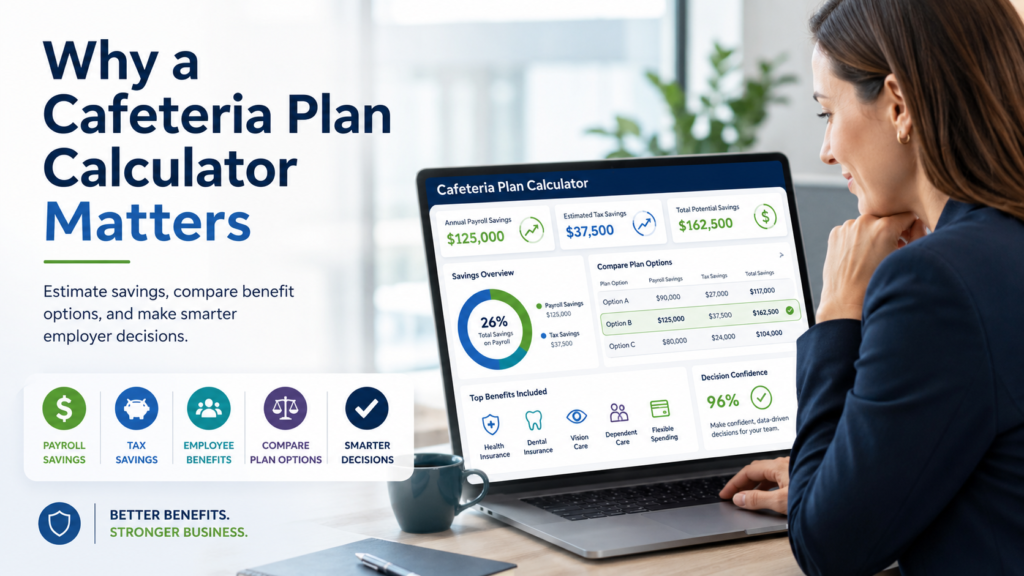
This is where a cafeteria plan calculator becomes useful.
A generic estimate is not enough. Employers need a savings estimate based on their own payroll, employee count, contribution structure, benefit elections, and workforce profile.
Employer Benefits Plan helps employers evaluate those details through a consultation-first approach. The goal is to identify whether the employer’s current setup supports a basic cafeteria plan, an advanced Section 125 benefit strategy, or another benefit savings structure worth comparing.
Why a Cafeteria Plan Calculator Matters
A cafeteria plan calculator helps employers move beyond theory.
Instead of relying on general claims, the employer enters or evaluates real business data, such as:
- Number of W-2 employees
- Average payroll
- Employee participation assumptions
- Benefit contribution amounts
- Health premium deductions
- FICA tax impact
- Payroll tax savings potential
- Workers’ compensation savings opportunities
- Administrative costs
- Current payroll setup
The best cafeteria plan advisor should not only say, “This plan saves money.”
They should help show where the savings come from, what assumptions drive the estimate, and what must happen operationally for the strategy to work.
That matters because employers need confidence before changing payroll deduction structures or introducing a new benefit strategy.
A strong savings estimate should answer:
- What is the estimated employer payroll tax savings?
- What is the estimated employee benefit value?
- Which employees are likely eligible?
- How does payroll handle the deduction structure?
- Does the current insurance setup support the strategy?
- What documentation is required?
- What implementation steps are needed?
- What ongoing administration is involved?
Employer Benefits Plan uses this type of consultation-first thinking to help employers compare options before they commit.
What Makes the Best Cafeteria Plan Advisor?
Not all cafeteria plan advisors bring the same level of strategy, clarity, or support.
A strong advisor should help employers make an informed business decision, not pressure them into a single plan.
Here are the traits to look for.
1. They Start With the Employer’s Pain Point
The best cafeteria plan advisor begins with the employer’s real concern.
That concern might be:
- Rising payroll taxes
- High FICA costs
- Workers’ compensation expenses
- Employee benefit dissatisfaction
- Confusion about Section 125 options
- Uncertainty about plan compliance
- Payroll disruption concerns
- Broker or carrier confusion
- Lack of employee participation
- Limited cafeteria plan guidance
A weak advisor starts with a product.
A strong advisor starts with the employer’s problem.
This is important because the right plan structure depends on the business. A company with 25 W-2 employees and simple health premiums has different needs than a 300-employee employer evaluating supplemental health benefits, wellness benefits, medical reimbursement arrangements, and workers’ compensation savings opportunities.
Employer Benefits Plan focuses on fit first. That means the consultation starts with the employer’s payroll, workforce, benefits, and savings goals before discussing implementation.
2. They Explain Basic and Advanced Options
The best cafeteria plan advisor should clearly explain the difference between a basic cafeteria plan and an advanced Section 125 benefit strategy.
Employers should not be boxed into one structure without seeing the comparison.
At minimum, the advisor should explain:
- What a basic cafeteria plan does
- What payroll deductions change
- What employee benefits qualify
- What documentation is required
- What employer savings are realistic
- What advanced strategies exist
- How supplemental health benefits fit
- How employee wellness benefits fit
- Whether medical reimbursement arrangements apply
- Whether workers’ compensation savings are worth evaluating
This matters because many employers only hear the basic cafeteria plan explanation. They never learn that a broader Section 125 strategy could create stronger value when properly structured, documented, implemented, and administered.
A strong advisor does not hide options. They compare them.
3. They Understand Payroll Integration
A cafeteria plan lives inside payroll.
If the advisor does not know how payroll deductions, tax treatment, employee elections, and benefit contributions connect, the employer faces problems later.
A strong cafeteria plan advisor should know how to coordinate with payroll providers regarding:
- Pre-tax deduction codes
- Post-tax deduction codes
- Employee eligibility
- Election amounts
- Pay frequency
- Effective dates
- Carrier billing alignment
- Payroll reports
- Taxable wage impact
- Employer contribution treatment
Employers should ask:
Will this advisor help coordinate with our existing payroll structure, or will they leave payroll to figure it out alone?
That question matters.
A cafeteria plan should not create paycheck confusion, deduction errors, carrier billing mismatches, or administrative stress.
Employer Benefits Plan helps employers assess payroll compatibility before implementation begins. This helps employers avoid disruption while comparing savings opportunities.
4. They Evaluate Existing Health Insurance Compatibility
A good cafeteria plan advisor should not assume the employer needs to replace existing health insurance.
For many employers, a Section 125 plan works alongside current group health coverage. Employees keep the same coverage, while eligible contributions are handled through pre-tax payroll deductions.
Advanced strategies require deeper coordination, but that still does not mean the employer automatically needs to replace the current carrier.
A strong advisor should evaluate:
- Existing group health insurance
- Current employee premium contributions
- Carrier billing cycles
- Employer contribution amounts
- Employee eligibility rules
- Supplemental benefit options
- Wellness benefit compatibility
- Medical reimbursement arrangement fit
- Broker or carrier coordination needs
This protects employers from unnecessary disruption.
Employer Benefits Plan’s no-replacement philosophy is especially valuable here. EBP helps employers look at what already exists first, then determine whether a basic or advanced strategy fits around that structure.
5. They Provide a Clear Savings Estimate
The best cafeteria plan advisor should provide a realistic savings estimate, not vague promises.
Employers should be cautious of language such as:
- Guaranteed savings
- IRS-approved plan
- Every employer qualifies
- No compliance risk
- One setup fits everyone
- Instant payroll savings with no details
A professional advisor should explain that savings depend on:
- Payroll size
- Employee count
- Employee participation
- Benefit elections
- Deduction structure
- Plan design
- Tax treatment
- Administrative accuracy
- Workers’ compensation factors
- Documentation quality
A strong advisor should use a cafeteria plan calculator or structured savings estimate to show the employer what the plan could mean financially.
The estimate should connect directly to the employer’s real payroll, not a generic national average.
6. They Discuss Compliance Without Overpromising
A cafeteria plan depends on proper structure and documentation.
A strong advisor should explain compliance in clear business language without making unsafe claims.
They should discuss:
- Written plan documents
- Employee eligibility rules
- Election procedures
- Qualified benefit categories
- Nondiscrimination considerations
- Payroll deduction treatment
- Employee communication
- Recordkeeping
- Ongoing administration
They should not say “IRS approved.”
Better wording includes:
- Tax-code-supported benefit provisions
- IRS-recognized benefit framework
- Internal Revenue Code provisions
- Properly structured benefit strategy
- Properly documented benefit strategy
- When properly structured, documented, implemented, and administered
Employers should work with an advisor who respects compliance language because sloppy wording often signals sloppy implementation.
Employer Benefits Plan uses compliance-safe education to help employers evaluate benefit strategies without exaggerated claims.
7. They Educate Without Making the Blog or Meeting Feel Generic
The best cafeteria plan advisor should educate the employer in a way that feels useful, not generic.
Employers need clear answers to practical questions:
- What does the plan change in payroll?
- What happens to existing health insurance?
- What savings are realistic?
- Which employees participate?
- What does HR need to communicate?
- What documents are needed?
- How does the plan affect employee paychecks?
- What happens during implementation?
- How does ongoing administration work?
Education should move the employer toward a clear decision.
It should not turn into a textbook explanation that defines Section 125 but never explains what the employer should do next.
Employer Benefits Plan helps employers compare real options so they can decide whether their current benefit setup is enough or whether a stronger savings structure deserves attention.
8. They Offer More Than One Plan Path
A good advisor should have more than one option to discuss.
For example, an employer might compare:
- A basic premium-only cafeteria plan
- A broader cafeteria plan with additional qualified benefits
- An advanced Section 125 benefit strategy
- Supplemental health benefit structures
- Employee wellness benefit strategies
- Medical reimbursement arrangement options
- Payroll tax savings strategies
- Workers’ compensation savings opportunities
The advisor should explain the pros, limitations, administrative needs, and compatibility considerations for each path.
This helps the employer avoid two common mistakes:
- Doing nothing because benefits feel too complicated
- Choosing the simplest plan without comparing stronger options
The best cafeteria plan advisor helps employers compare the full picture before they decide.
9. They Have Strong Industry Connections
Cafeteria plan implementation often touches several parties.
These include:
- Payroll providers
- Benefits brokers
- Insurance carriers
- HR teams
- Compliance partners
- Tax professionals
- Enrollment support teams
- Supplemental benefit providers
- Wellness benefit providers
- Plan administrators
A strong advisor should know how these pieces connect.
Helpful industry relationships matter because employers often need coordination, not just advice. The advisor should help point the employer in the right direction and support communication between the right parties.
This does not mean the advisor replaces legal, tax, payroll, or carrier professionals. It means the advisor helps the employer organize the process and identify which questions need answers.
Employer Benefits Plan is designed for that role: helping employers compare options, evaluate fit, and prepare for next steps with greater clarity.
10. They Focus on Fit Before Implementation
The best cafeteria plan advisor does not rush implementation.
They first evaluate:
- Payroll compatibility
- Current health insurance structure
- Employee count
- W-2 workforce profile
- Employee eligibility
- Pay frequency
- Current deduction setup
- Benefit contribution structure
- Potential FICA savings
- Employer payroll tax savings
- Workers’ compensation factors
- Employee wellness benefit opportunities
- Supplemental health benefit fit
- Administrative readiness
- Documentation needs
This step matters because a plan that sounds attractive still has to work inside the employer’s actual payroll and benefits environment.
Employer Benefits Plan follows this consultation-first approach. EBP helps employers compare basic cafeteria plan options with advanced Section 125 benefit strategies before any implementation decision.
That gives employers a lower-risk way to explore savings without disrupting existing payroll or insurance relationships.
Questions to Ask Before Choosing a Cafeteria Plan Advisor
Before selecting a cafeteria plan advisor, employers should ask direct questions.
Strategy Questions
- Do you compare basic cafeteria plans with advanced Section 125 strategies?
- Do you explain more than one plan option?
- Do you evaluate payroll tax savings and FICA savings?
- Do you look at supplemental health benefits or wellness benefits?
- Do you assess workers’ compensation savings opportunities?
Payroll Questions
- Will this work with our current payroll provider?
- What deduction codes are needed?
- How are employee elections handled?
- How does the plan affect taxable wages?
- What payroll reports are required?
Insurance Questions
- Does this require replacing our current health insurance?
- How does the plan work with our current carrier?
- Do employee premium contributions qualify for pre-tax treatment?
- Are supplemental benefits compatible?
Compliance Questions
- What written plan documents are needed?
- How are employee elections recorded?
- What nondiscrimination rules apply?
- What ongoing administration is required?
- What wording should we avoid?
Savings Questions
- What is our estimated employer payroll tax savings?
- What is our estimated FICA tax savings?
- What assumptions drive the estimate?
- How does employee participation affect savings?
- What costs or administrative responsibilities apply?
If an advisor cannot answer these clearly, the employer should keep comparing.
Why Employer Benefits Plan Is a Strong First Step
Employer Benefits Plan helps employers compare basic benefit options with advanced tax-advantaged benefit strategies.
The goal is not to force every employer into the same plan. The goal is to help each employer determine which strategy fits its payroll structure, workforce, health insurance setup, employee needs, and savings goals.
EBP helps employers evaluate:
- Whether a basic cafeteria plan is enough
- Whether an advanced Section 125 strategy creates stronger value
- Whether payroll supports the deduction structure
- Whether current health insurance is compatible
- Whether supplemental health benefits fit
- Whether employee wellness benefits add value
- Whether medical reimbursement arrangements belong in the strategy
- Whether employer payroll tax savings are worth pursuing
- Whether workers’ compensation savings opportunities exist
- What next steps make sense before implementation
That is the difference between a basic cafeteria plan vendor and a strategic benefits consultation resource.
Final Thoughts: The Best Cafeteria Plan Advisor Helps You Compare Before You Commit
Finding the best cafeteria plan advisor is not about finding someone who gives the fastest explanation.
It is about finding someone who helps your business compare the right options.
A basic Section 125 plan might be enough for some employers. Other employers should evaluate advanced Section 125 benefit strategies involving payroll tax reduction, FICA tax savings, supplemental health benefits, employee wellness benefits, medical reimbursement arrangements, and workers’ compensation savings opportunities.
The right advisor helps employers see what they might be missing before they make a decision.
Employer Benefits Plan gives W-2 employers a practical starting point. Through a consultation-first approach, EBP helps employers evaluate current payroll, existing benefits, savings potential, and plan compatibility before implementation begins.
Before choosing a cafeteria plan advisor, compare your options.
Before assuming your current plan is enough, evaluate the broader strategy.
Before leaving payroll tax savings or employee benefit value unexplored, request a savings consultation with Employer Benefits Plan.