

FICA tax savings comparison: which strategy pays most
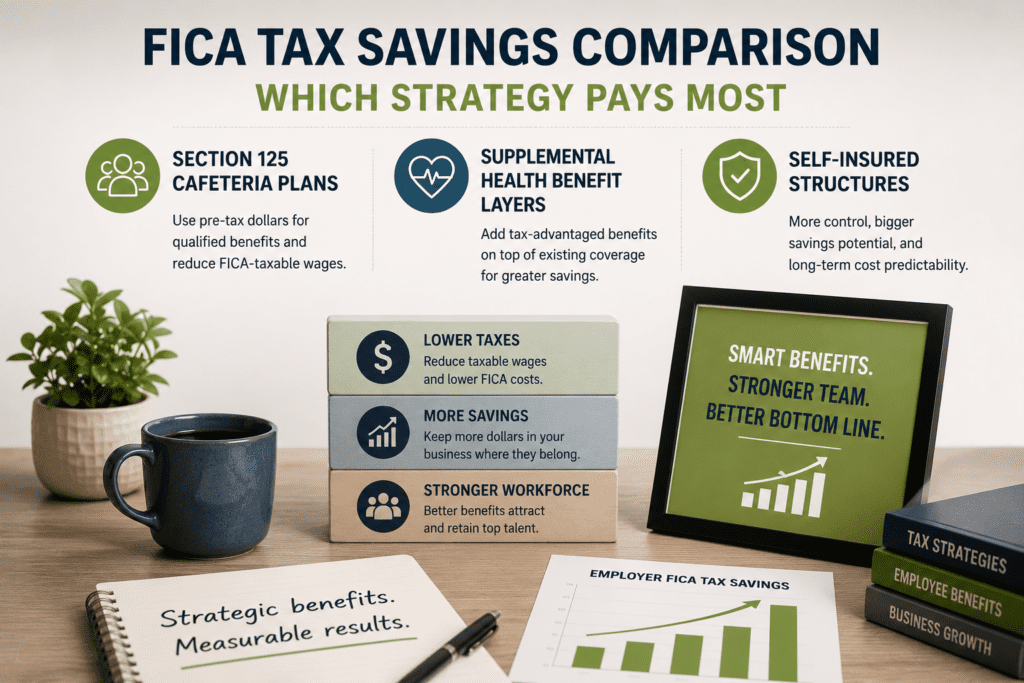
A FICA tax savings comparison across Section 125 cafeteria plans, supplemental health benefit layers, and
self-insured structures reveals that many employers are paying more in payroll tax than the code requires, not
because the rates are unavoidable, not because there’s some loophole they’re missing, but because they haven’t
structured their benefits to take advantage of what the tax code already allows. The employer share of FICA is 7.65%
of every dollar of taxable wages: 6.2% for Social Security on wages up to $184,500 in 2026 plus 1.45% Medicare on
all covered wages. When taxable wages decline because an employee redirects compensation into a qualified pre-tax
benefit, employer FICA liability drops by exactly that percentage. The math is straightforward, but the arrangement
must be properly designed, documented, implemented, and reviewed for the employer’s specific facts.
Three approaches do most of the work: Section 125 cafeteria plans, supplemental health benefit layers, and
self-insured plan structures. Each reduces employer FICA exposure through the same underlying mechanism, but
they differ significantly in savings ceiling, compliance requirements, and which employers they actually fit. This article
breaks down all three side by side so you can evaluate which strategy matches your payroll structure, not just which
one sounds appealing in the abstract. Employer Benefits Plan helps employers evaluate whether these arrangements
may fit their workforce and coordinates the review process with appropriate implementation and compliance partners
before any commitment is required.
How FICA Reduction Actually Works: The Mechanics Behind the Savings
Employer FICA liability is a straightforward percentage of taxable wages. When an employee’s taxable wages decline
because of a qualified pre-tax benefit, the employer’s FICA obligation declines proportionally, no complex maneuver
required. The legal architecture is already built into the tax code under IRS rules for qualified benefit plans.
The benefits that reduce FICA-taxable wages include: employer and employee HSA contributions made through
payroll, health FSA salary reductions under Section 125, other Section 125 cafeteria plan salary reductions for
qualified benefits, and qualified commuter benefits up to the IRS monthly limits: $340 for transit and $340 for parking in
2026. One common misconception worth correcting: employee elective 401(k) or 403(b) deferrals are not excluded
from FICA, even though they reduce income tax. They reduce federal income tax wages, but not FICA-taxable wages.
Employer matching contributions, on the other hand, are excluded. The distinction matters when comparing strategies.
The employer savings formula is direct: pre-tax contributions multiplied by 7.65% for employees below the Social
Security wage base. An employee contributing $5,000 pre-tax generates $382.50 in employer FICA savings. For
wages above the $184,500 Social Security cap, only the 1.45% Medicare portion applies to additional pre-tax
contributions. For small to mid-size employer workforces where most employees earn well below that cap, the full
7.65% rate applies across the participating population, which makes the payroll tax savings highly predictable.
FICA Tax Savings Comparison: Section 125 Cafeteria Plans
A Section 125 cafeteria plan allows employees to pay for qualified benefits, including health insurance premiums, FSA
contributions, and dependent care, using pre-tax dollars through a salary reduction arrangement. When the salary
reduction is properly structured, those amounts are removed from FICA-taxable wages for both the employee and the
employer. Section 125 is a commonly implemented starting point for any benefits-driven payroll tax savings strategy.
Savings Example
At $5,000 in annual pre-tax elections per employee, employer FICA savings land at approximately $382 per
participant: $5,000 x 7.65%. Scale that across a 30-person workforce with average elections at that level, and annual
employer savings reach roughly $11,475 before plan costs. The ceiling is determined by how much each employee
actually elects and the IRS contribution limits for each benefit type. Higher average elections push savings higher;
lower participation compresses them.
Cost Structure
Setup fees typically run between $0 and $1,500 depending on plan complexity. A premium-only plan sits at the lower
end; a full cafeteria plan with FSA components sits higher. Ongoing administrative fees average $3 to $8 per
employee per month, and annual compliance expenses including nondiscrimination testing add a few hundred to over
$1,000 depending on the vendor.
Using 30 employees with $5,000 average pre-tax elections as the baseline: gross employer FICA savings of
approximately $11,475, minus annual costs of roughly $2,300 to $3,050, produces a net gain in the range of $8,400 to
$9,175 per year. That’s a solid return on a low-complexity setup, and it’s not the highest return available.
Compliance Checklist
Nondiscrimination testing requirements apply annually under Section 125. Full cafeteria plans with FSA components
face more involved testing than a premium-only plan. Employers with 100 or fewer employees may qualify for the
Simple Cafeteria Plan safe harbor, which generally satisfies nondiscrimination rules when minimum contribution and
eligibility standards are met. For an overview of nondiscrimination testing considerations, see this guide on Section
125 nondiscrimination testing.
FICA Tax Savings Comparison: Supplemental Health Benefit Layers
A supplemental health benefit layer sits on top of existing group health insurance. It doesn’t replace the current plan.
It’s designed to complement what’s already in place by routing additional employer benefit contributions through a
tax-advantaged structure that qualifies for FICA exclusion under IRC Section 105(b). When properly designed and
documented, a supplemental health benefit layer may increase the amount of qualifying benefit value that is excluded
from FICA-taxable wages. Employer Benefits Plan works specifically in this space, helping W-2 employers review
whether this type of layer may fit their existing payroll and insurance arrangements.
The key technical requirement is that the benefit must be structured as a true medical reimbursement arrangement,
not a disguised wage substitute. Under IRS rules, a payment qualifies for FICA exclusion under Section 105(b) when it
is provided under a written accident or health plan, covers actual medical care expenses, and is not available as a
cash alternative. If the employee can elect cash instead of the benefit, the IRS treats it as taxable wages. Plan design
and documentation must reflect a genuine health benefit, not a bonus with different paperwork.
Savings Example
When structured correctly, a supplemental health benefit layer can generate materially more than the Section 125
baseline. Industry models based on average redirected compensation amounts suggest employer FICA savings in the
range of approximately $600 to $650 per participating W-2 employee annually. Compare that to the $382 baseline
from a Section 125 plan alone. For a 50-employee workforce, that difference amounts to roughly $11,000 to $13,500
per year in additional payroll tax savings. The savings are higher because the supplemental layer increases the total
qualifying benefit value being redirected, which directly expands the FICA-exempt wage base beyond what basic
cafeteria plan elections achieve.
Compliance Checklist
Compliance requirements are moderate. The plan must satisfy IRS, ERISA, ACA, and HIPAA rules, and plan
documents need to be properly drafted and maintained. The compliance load is real but contained compared to a
self-insured structure. Implementation is additive: existing health insurance stays in place, payroll integration doesn’t
require a system overhaul, and no employee benefits are disrupted. For most small to mid-size employers, that
combination of meaningful savings and manageable compliance burden makes the supplemental layer the most
efficient play in the stack.
FICA Tax Savings Comparison: Self-Insured Health Plan Structures
Self-insured health plans shift the financial risk of medical claims from an insurance carrier to the employer, usually
paired with stop-loss coverage to cap catastrophic exposure. Because the employer controls benefit design more
directly, there’s more room to optimize plan contribution structures in ways that reduce FICA-taxable wages. Industry
data and plan-level modeling suggest potential savings on total health plan costs that can significantly exceed what a
Section 125 plan or supplemental layer alone can produce, though actual results depend heavily on workforce size,
claims experience, and plan design.
Compliance Checklist
The compliance burden is proportionally higher. ERISA requires a written plan document, a Summary Plan
Description, named fiduciary designation, and formal claims and appeals procedures. ACA reporting applies
regardless of employer size: non-ALE employers file Forms 1094-B and 1095-B; ALE employers file Forms 1094-C
and 1095-C. Form 5500 filing requirements depend on participant count and plan structure.
State regulations add additional complexity, particularly in California, New York, and other high-regulation states
where stop-loss rules, carrier requirements, and self-insurance restrictions vary significantly. Small employers should
also expect state-imposed minimum attachment points: some states restrict stop-loss deductibles below certain
thresholds for smaller groups, with minimums that can reach $20,000 or more depending on the state.
When to Choose This Option
The practical threshold for self-insured viability is generally 50 or more W-2 employees, with adequate cash reserves
to absorb claims variability before stop-loss kicks in and the administrative capacity to manage a third-party
administrator relationship. Below that threshold, administrative cost and cash flow unpredictability often offset the
savings. The decision isn’t binary: some employers in the 50-to-100 employee range benefit more from layering a
supplemental health benefit program onto their current fully insured plan rather than converting to self-insurance
entirely

Comparing the Three Strategies: Savings, Complexity, and Fit
Here’s how the three approaches compare on the dimensions that drive the decision:
Section 125 cafeteria plan:
Approximately $382 per participating employee annually in employer FICA savings; low
setup complexity; well-supported by payroll software; compliance is manageable but requires annual
nondiscrimination testing.
Supplemental health benefit layer:
Approximately $600 to $650 per participating W-2 employee annually based on
modeled assumptions; requires proper plan design and compliance review under ERISA, ACA, and HIPAA;
integrates without disrupting existing benefits or payroll; best balance of savings and complexity for most small to
mid-size employers
Self-insured health plan:
Highest savings potential, potentially thousands per employee annually depending on
health plan spend, with the highest compliance burden: ongoing TPA coordination, multi-regulatory reporting, and
stop-loss management; best suited for employers with 50 or more W-2 employees and the operational
infrastructure to manage it.
The savings hierarchy is straightforward. Section 125 is the floor: accessible, proven, and limited by IRS contribution
caps and employee participation rates. The supplemental layer is the middle ground: meaningfully higher payroll tax
savings than a basic cafeteria plan, with a compliance profile most small to mid-size employers can manage.
Self-insured structures are the ceiling for employers with the right size, cash flow, and administrative capacity.
For employers with 10 to 100 W-2 employees, the supplemental health benefit layer tends to deliver the strongest net
return per dollar of compliance effort, particularly when average election sizes and participation rates are factored
against admin costs. For employers who already have a Section 125 plan in place, the practical question is whether
that existing structure is capturing all available FICA savings or whether a supplemental layer would close a
meaningful gap
How to Choose the Right Strategy for Your Payroll Structure
The right approach depends on variables specific to your workforce, not on which strategy sounds best in a general
comparison. Workforce size, average salary distribution, current benefits structure, state of operation, and payroll
setup all influence which approach generates the best net return. A 15-person professional services firm in California
operates in a fundamentally different cost environment than a 75-person manufacturer in Texas. The savings potential
and the compliance obligations both shift with those variables.
This is why a consultation-first approach beats modeling from generic assumptions. Employer Benefits Plan runs a
structured eligibility review covering workforce composition, W-2 employee structure, and payroll fit, then produces a
personalized savings estimate covering FICA tax savings, workers’ compensation savings where applicable, and
supplemental benefit value. The estimate reflects your actual payroll data, not industry averages. No commitment is
required to see the numbers.
For employers who already have a Section 125 plan in place, the review identifies whether a supplemental health
benefit layer captures additional savings the current structure is leaving behind. For employers without any structured
pre-tax program, starting with a full review is faster and more accurate than working from ballpark figures. Either way,
the goal is a savings projection that holds up when it hits your actual payroll system
Bottom Line on FICA Savings Strategies
Running a proper FICA tax savings comparison across the three main strategies makes the decision considerably
cleaner. Section 125 cafeteria plans are the accessible baseline. They work for nearly any employer with W-2
employees, but their savings ceiling is capped by contribution limits and participation rates. Supplemental health
benefit layers expand that ceiling meaningfully, with a compliance profile that fits most small to mid-size W-2
workforces. Self-insured structures offer the highest savings potential but belong in the conversation only for
employers with the size, cash reserves, and administrative infrastructure to manage them.
The most useful analysis you can run isn’t between three abstract strategies. It’s between your actual payroll structure
and a savings estimate built specifically around your workforce, one that accounts for your employee count, salary
distribution, and existing benefits setup. That’s the number that tells you which approach is worth pursuing. To see it
for your business, request a review through Employer Benefits Plan. There’s no cost to the review and no commitment
required before you see what your payroll structure qualifies for.
Review Whether This Strategy May Fit Your Workforce
Employer Benefits Plan helps employers review whether a supplemental benefits and payroll-savings strategy may support potential savings and employee benefit value.